


Welcome! As part of its ongoing mission to document the Art and Production History of Star Trek, this site will present technical articles on Star Trek prop and costume authentication - focusing on The Original Series - with detailed photos and episode screenshots to complement the information presented; as well as feature pictorials to showcase Star Trek memorabilia in private & public collections, present rare Behind The Scenes TOS imagery & discuss other topics.
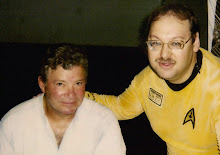
Gerald Gurian is a 40+ year collector of screen used Star Trek memorabilia and a passionate fan of TOS
     
- Star Trek TOS At Auction Part I - Gurian Collection Highlights - Greg Jein TOS Hero Type II Phaser
-Authenticating a TOS Communicator -6 Myths About Star Trek Prop Design -Star Trek 3rd Season Command Tunic
- Design Features of TOS Tricorders -Star Trek Props At National Air & Space - TOS Leatherette Tricorder
- TOS Federation Sciences Dress -Desilu Studio TOS Prop Fabrication - Unreleased Allen/Gurian Prop Photos
- The Beautiful Women of TOS Part I -TOS U.S.S. Enterprise 11' Filming Model - Captain Kirk's Chair from TOS
- Spock Ears -TOS Control Panels & Displays - Mr. Spock's Science Station
- TOS Soundstage at Desilu -TOS Shatner Romulan Pants - The Beautiful Women of TOS Pt. II
- TOS Galileo Shuttlecraft -Greg Jein TOS Cage Laser Pistol - TOS 3rd Season Midgrade Type II Phaser
- Dr. McCoy's Sickbay on TOS -TOS Balok Puppet Head - Captain Kirk "Mirror, Mirror" Tunic
- Greg Jein TOS Hero Tricorder -1992 Smithsonian TOS Cast Video - TOS 1st Season Command Tunic
- TOS "Where No Man" Silver Contact Lenses -TOS Special Effects: The Transporter - The Art of Matt Jefferies
- TOS "Space Seed" Gold Mesh Jumpsuit -Gorn Costume from "Arena" - Rare TOS Behind-the-Scenes Videos
- TOS Stunt Type II Phaser -1993 Bill Theiss Estate Auction - TOS Shatner Command Dress Tunic
- TOS Elasian Royal Guard Tunic -TOS Finnegan Silver "Shore Leave" Tunic - TOS Science Officer Tunic "The Cage"
- TOS Shatner Early 1st Season Command Tunic -William Shatner TOS Tunics At Auction - TOS Shatner Late 1st Season Command Tunic
Showing posts with label tos. Show all posts

Thursday, January 1, 2009

TOS Special Effects: The Transporter

The transporter device, which made its first appearance in “The Cage” (1964) - the pilot episode for Star Trek, was an ingenious creation that, according to The Star Trek Encyclopedia (Pocket Books, 1994) “briefly converts an object or person into energy, beams that energy to another location, then reassembles the subject into its original form.” Its usage in The Original Series was a necessity to help the Desilu production team control budget, as discussed by TOS Assistant Director and later Co-Producer Robert Justman in the book “Inside Star Trek: The Real Story” (Pocket Books, 1996) …

My other major worry (the first being no gravity in outer space, which was “solved” by Gene Roddenberry’s decision to equip the Enterprise with it’s own artificial gravity field) was the enormous cost of optical effects to land the Enterprise on a new planet every week. Gene’s clever solution: the transporter effect, “beaming” people to other locations with no apparent loss of molecules, other than when required for story purposes.
When I first viewed the transporter effect, I was as curious as anyone else might be and asked the inventive Darrell Anderson how he achieved it. Darrell said, “I just turned a slow-motion camera upside down and photographed some backlit shiny grains of aluminum powder that we dropped between the camera and a black background.”

And using a piece of Sandy Courage “shimmer” music, we gave the visual effect its distinctive sound. Gene’s creative solution to my “landing” dilemma resulted in a new catch-phrase and a wealth of bumper stickers, “Beam me up, Scotty.”
Incidentally, the exact words “Beam me up, Scotty” were never spoken in the dialogue of a TOS episode. A typical command might be “Mr. Scott, one to beam aboard.”

A full technical description of the film editing process involved in creating the Transporter effect is provided by Stephen Whitfield in “The Making of Star Trek” (Ballantine Books, 1968) …

The dematerialization and rematerialization of crewmen (the Transporter Effect) is accomplished as follows:

  1. The crewman to be transported steps into the transporter and is filmed.
  2. As the camera continues to run, the crewman steps out of camera range and the empty set is filmed. Later, the action of the man leaving the set will be clipped out of the film … and the footage spliced into one piece.
  3. On a duplicate piece of film shot in 2, above, a mask, exactly outlining the person’s figure as he appeared in the transporter, is superimposed, creating a piece of film with a “hole” in it.
  4. These pieces of film are then rephotographed simultaneously in the optical printer:
    a. The original film.
    b. The masked film.
    c. A length of film containing only the glitter effect of the transporter. To obtain the “glitter effect”, aluminum dust was photographed as it was dropped from overhead, falling through a beam of high-intensity light.
  5. The “glitter effect” goes through the “hole” in the second piece of film and thus coincides with the outline of the crewman. When the film is run, the man is slowly “faded” out of the picture, momentarily leaving the glitter effect in place of his body. The glitter is then faded (“dissolved”) out as well.
Pony Horton, a professional Visual Effects artist who worked at Van der Veer Photo Effects in the late 1970's, has reported some additional insights on the development of the Transporter special effect for TOS.  (Van der Veer Photo Effects was one of several optical houses; including The Westheimer Company, Film Effects of Hollywood and others; who were brought in sometime early during the first season of production of the Original Series to help process the tremendous backlog of sfx shots required for the episodes that the original contractor - the Howard Anderson Company - could not efficiently handle all by itself.  The Anderson Company had previously done all the effects for the 2 Star Trek pilot productions: "The Cage" and "Where No Man Has Gone Before", as well as "The Corbomite Maneuver" and possibly others of the very earliest regular season episodes.)   According to Mr. Horton, a colleague of his at Van der Veer was Hugh Wade, who became one of the primary optical printer operators at the company, and who was "the man who actually created the authentic effect used by the other houses.  It was only glitter (= aluminum dust photographed falling through a high-intensity light beam) during the first tests of the VFX.  It was never glitter on the show: the final effect was Alka-Seltzer shot in hot water".  Horton indicated that Hugh Wade originally created the effect back in 1964 or 1965, and that Wade was inspired to use Alka Seltzer since he was familiar with its appearance after having been previously involved in shooting a number of the television commercials for the product.  Horton himself went on to become the VFX Supervisor for the well known fan film series Star Trek: The New Voyages, where he replicated the '60s technique to create the Transporter special effects for those productions.   Special thanks to Pony Horton for his kindness in providing the following imagery from New Voyages; which includes a shot of the base Alka Seltzer sparkles themselves as well as some episode screenshots that incorporate them, presented below ...


In TOS, it was established that transporters are unable to function when deflector shields are raised. Transporter malfunctions were also the source of some extraordinary storyline developments in The Original Series. In the first season episode “The Enemy Within”, for example, a mishap during a routine transport aboard ship causes both a “good” and “evil” Kirk to be created. Fortunately, Scotty manages to diagnose the problem and use the device to reassemble the Captain into his original form and rescue a stranded landed party on the verge of freezing to death. In the popular second season episode “Mirror, Mirror”, it is another transporter accident, triggered by an unexpected ion storm, that causes the landing party to exchange places with identical “barbarian” counterparts from a parallel or mirror universe, that were in the act of beaming back to their ship at the same instant in time.

In Star Trek: The Next Generation, the audience is provided with more details on the underlying operating theory and some of the critical technical components of the device. Specifically, in the TNG episodes “The Hunted” and “Power Play”, the annular confinement beam or ACB is introduced. As described in The Star Trek Encyclopedia, it is “a cylindrically shaped forcefield used to insure that a person being transported remains within the beam. Failure to remain within the confinement field can cause a dangerous release of beam energy, possibly fatally injuring the transport subject and those nearby.” Transporter Pattern Buffers played a significant role in the famous TNG episode “Relics”, which featured a guest star appearance of actor James Doohan reprising his role as Montgomery Scott. As described in The Star Trek Encyclopedia, the pattern buffer was a key transporter component “in which a transport subject’s image is briefly stored so that transmission frequency can be adjusted to compensate for the Doppler effect caused by any relative motion between the transport chamber and the target. Because of the criticality of this subsystem, two buffers must be operated in synchronization with each other so that in case of failure of one unit, the beam can be immediately handed off to the backup.” Scotty successfully modified the pattern buffers of the U.S.S. Jenolen in “Relics” so that he was able to survive for 75 years in a suspended state awaiting rescue by the USS Enterprise-D.

One of the most often cited reasons why some scientists believe that the development of a “real” working transporter may be impossible has to do with an important and central part of quantum mechanics called the Heisenberg Uncertainly Principle. This principle states that it is impossible to know with absolute certainly both the location and motion vector of a subatomic particle (for example, an electron orbiting a nucleus in a target atom); although, any one of the two characteristics, either the location or the vector of the particle, may be precisely known. A transporter device would have to be able to derive the exact positional and vector data of all of the subatomic particles in the subject being “beamed” in order to reassemble the person or object at the destination location. In Star Trek: The Next Generation, there is mention of a Heisenberg Compensator – another key piece of transporter technology – but no detailed explanation of its operating theory is provided.

Complications with Transporters in the ST:TNG years were also possible. A somewhat interesting affliction called “Transporter psychosis” is described in The Star Trek Encyclopedia as follows:

Transporter psychosis. Rare medical disorder caused by a breakdown of neurochemical molecules during transport. Transporter psychosis was first diagnosed in 2209 by researchers on planet Delinia II. The condition affected the body’s motor functions, as well as autonomic systems and higher brain functions. Victims were found to suffer from paranoid delusions, multi-infarct dementia, tactile and visual hallucinations, and psychogenic hysteria.
No wonder why Dr. McCoy had his reservations about stepping into the Transporter chamber during the feature film years!

Below are some photos of the Transporter Chamber and the Transporter Console as seen in TOS. (Not all Star Trek fans may know that the floor discs used in The Original Series transporter chamber were reused in the production of TNG and Voyager and were, in fact, installed as the ceiling discs for those transporter chambers.) …


And some photos of a rematerialization special effect as seen in the TOS first season episode “Shore Leave” …


Finally, perhaps the first recorded use of a transporter on a dog-like creature since the alien dog in “The Enemy Within” met with an unfortunate, premature demise. I checked for Transporter psychosis afterwards and did not detect anything; although there is a slight twitching of the tail following rematerialization …

Sunday, December 28, 2008

How Nichelle Nichols helped America choose its President

Today Nichelle Nichols, the beautiful actress who made television history with her portrayal of Lt. Uhura, celebrates her 76th birthday. Also on this day, the nation is little more than 3 weeks away from the inauguration of its first African-American President. Regardless of which candidate one individually supported in the election; all Americans can take pride in the fact that the country truly chose its next leader based upon an assessment of the content of his character and abilities as opposed to the color of his skin. Without achieving a broad support from all demographic groups, as African-Americans comprise approximately 12.3% of the U.S. population, Barack Obama could not have been victorious.

Very few individuals can look back on their careers and can say that they played a significant role in the shaping of the consciousness of their nation; but I believe that Nichelle Nichols can do so. With her pioneering role as a senior officer aboard a harmonious, multi-racial starship crew on 1960’s television – a role that completely broke down the stereotypes of those years – Nichelle helped to establish the enlightened mindset that enabled the election of the President in 2008. Remember, in the America of the 1960s, when the time came for filming the memorable scene in the Star Trek episode “Plato’s StepChildren” (airdate Nov. 22, 1968) which contained the first televised interracial kiss in American television history; there was much controversy and concern among the network executives that broadcasting something as innocent by today’s standards as a kiss would generate tremendous backlash from the viewing public – particularly against the networks Southern affiliate stations. As it turned out, the episode was greeted with a huge and overwhelmingly positive public response, with the exception of a single objection, as discussed by Nichelle in her autobiography “Beyond Uhura” (Putnam, 1994) …

… I received a note from Gene that read: “Thought you’d be interested. This is the only “negative” fan mail we got.” Attached was a photocopy of this letter: I’m a white Southern gentleman, and I like Star Trek. I am totally opposed to the mixing of the races. However, any time a red-blooded American boy like Captain Kirk gets a beautiful dame in his arms that looks like Uhura, he ain’t gonna fight it.” It only took a few days before some of the front-office executives … began boasting of their support for this brave step in television history.

Of course it wasn’t a single event like the kiss which would help transform attitudes. It was several years of regularly portraying the role of Lt. Uhura – entering the homes of the viewing public during the initial run of the series and, indeed, perhaps more significantly, during the many years in which the popularity of the show grew tremendously during reruns in syndication.

Not all fans of Star Trek: The Original Series are aware that Nichelle Nichols came extremely close to leaving the show at the completion of the first season; and had in fact met with Gene Roddenberry and resigned after filming the last episode of the year. It was an unanticipated historic encounter literally the next day that caused Nichols to re-evaluate her decision. As described in “Beyond Uhura” …

The following evening I attended an important NAACP fund-raising event. I was chatting with someone when a man approached and said, “Nichelle, there is someone who would like to me you. He’s a big fan of Star Trek and of Uhura.”

I turned to greet this “fan” and found myself gazing upon the face of Dr. Martin Luther King, Jr. I was stunned, and I remember thinking, Whoever that fan is, he’ll just have to wait.

The man introduced us. Imagine my surprise when the first words Dr. King uttered were, “Yes, I am that fan, and I wanted to tell you how important your role is.”

He began speaking of how he and his children watched Star Trek faithfully and how much they adored Uhura. At that moment the impact of my decision really struck me. Nevertheless, I replied, “Thank you, Dr. King, but I plan to leave Star Trek.”

“You cannot,” he replied firmly, “and you must not. Don’t you realize how important your presence, your character is?” he went on. “Don’t you realize this gift this man has given the world? Men and women of all races going forth in peaceful exploration, living as equals. You listen to me: Don’t you see? This is not a Black role, and this is not a female role. You have the first nonstereotypical role on television, male or female. You have broken ground –“

“There have been other Black stars,” I countered.

“In TV?” he replied. “Yes, Beulah, Amos and Andy. Do I need to go further?”

“No,” I answered softly.

“You must not leave. You have opened a door that must not be allowed to close. I’m sure you have taken a lot of grief, or probably will for what you’re doing. But you changed the face of television forever. You have created a character of dignity and grace and beauty and intelligence. Don’t you see that you’re not just a role model for little Black children? You’re more important for people who don’t look like us. For the first time, the world sees us as we should be seen, as equals, as intelligent people – as we should be. There will always be role models for Black children; you are a role model for everyone.

“Remember, you are not important there in spite of your color. You are important there because of your color. This is what Gene Roddenberry has given us.”

All that weekend Dr. King’s words echoed in my mind as I weighed every factor. Perhaps he was right: Perhaps Uhura was a symbol of hope, a role model. And if that were the case, did I not owe it another chance? Granted, Uhura’s full potential had not been realized, and sadly, probably wouldn’t be. But she was there, wasn’t she? And that had to count for something.

When I returned to work on Monday, I went to Gene’s office first thing and told him about my conversation with Dr. King and my decision to stay.

A tear came to Gene’s eye, and he said, “God bless that man. At least someone sees what I’m trying to achieve.”

I’m certain I join with millions of fellow Star Trek fans who wish Nichelle Nichols the very best regards on her birthday today. And, if any person is worthy of receiving a special invitation to view the upcoming Inaugural ceremonies from the VIP Presidential Platform, I can think of few more deserving than Nichelle Nichols.


Saturday, December 27, 2008

1969 Interview with William Shatner

William Shatner appeared on The Mike Douglas Show in late February of 1969 and discussed his role as Captain Kirk. At the time that this interview took place, all of the episodes in Season 3 had been filmed, yet the final four were still to be broadcast. (The final episode, Turnabout Intruder, was shown on June 3, 1969). This interview lasts approximately 6 minutes.


Friday, December 26, 2008

Star Trek: The Original Series Tribbles

Below are some photos of a screen used Tribble from the TOS 2nd season episode "The Trouble with Tribbles", originally broadcast on Dec. 29, 1967 ...


Left:

Right:


Front:

Rear:

Top:

Bottom:

And a screen used Tribble from the celebrated 1996 Deep Space Nine episode "Trials and Tribble-ations" ...


Some TOS tribbles on display at the Science Fiction museum in Seattle, from the Paul Allen Family Collection ...

And a rare, "working Tribble" from The Original Series, which employs part of a battery-powered toy dog to enable a walking motion. Other hero tribbles were outfitted with squeeze balls and ballons to give the appearance of breathing.


A screenshot from the 1967 episode showing Captain Kirk almost shoulder deep in Tribbles. These are the hazards of commanding a Starship ...

And a group of tribbles relaxing over the holidays. The large, white one is clearly the next step in the evolution of the species ...

Sunday, October 12, 2008

The Galileo Shuttlecraft

The Galileo Shuttlecraft made its first appearance halfway through Season One of TOS, in the episode appropriately entitled “The Galileo Seven” – which was originally broadcast on January 5, 1967. It’s interior design was created by the celebrated Star Trek Original Series Art Director and Production Designer Matt Jefferies; while it’s exterior appearance was actually created by Gene Winfield, a well known custom car builder and primarily automotive designer who had contracted with the AMT plastic model company. AMT had reached an agreement with the Desilu Star Trek office to build the filming miniature of the shuttlecraft in exchange for the rights to manufacture and market model kits of it and other TOS spacecraft such as the Enterprise and the Klingon Battle Cruiser.

Jefferies did create several concept sketches for the exterior of the Galileo; and his preferred solution was more aerodynamic than the final design, featuring many curved surfaces, but the Winfield version was adopted to facilitate manufacturability of the AMT model. In an interview published in the April 2000 Issue 12 of Star Trek: The Magazine, Jefferies discussed his concept: “Basically it was a teardrop thing, and the whole side panel, the outside door, would slide back, and you could just step right off on the ground. The seats were like bicycle seats mounted on each side of the keel.” When the more-boxy final exterior design was approved, Jefferies reworked his concept of the interior to conform.

In addition to the filming miniature, both a full scale interior set as well as a three-quarters scale exterior set were created on the Desilu soundstage. Regarding the exterior set construction, Jefferies remarked “A certain percentage of that had to be done in the studio shops. They brought it all over in a big truck. It was on a steel frame; it was bulky, and it was heavy. I think if it had been lighter and easier to move, and of course if we’d had the time or the equipment, we would have probably got much more use out of it. We could have lowered it to the surface and had the doors open and the people get out or get in. But it would have taken a lot of engineering and probably beefing up the stage structure to be able to lower the thing as it was.”

Below are some of Jefferies concept sketches of the exterior design…


and his original concept of the shuttlecraft’s interior appearance …

Some sketches of the final Winfield exterior design …


and the final Jefferies interior …


Below are some rare photos of the Galileo exterior set construction process …


And some archival photos and screenshots of the shuttlecraft as it appeared in numerous Original Series episodes such as “The Galileo Seven”, “The Menagerie”, ”The Doomsday Machine”,”Metamorphosis”, ”The Immunity Syndrome” and “The Way To Eden”:


The filming miniature as seen in some Enterprise hangar deck screenshots …


After the Original Series completed filming in 1969, it is known that the three-quarter scale shuttlecraft exterior mockup spent many years stored outdoors where it unfortunately suffered significant structural deterioration …


Approximately 18 years ago, it was purchased for $3000 and hauled from California to Akron, Ohio on a specially-constructed trailer and was housed in a hangar at the Canton / Akron airport (CAK). From 1991-1993, the Galileo exterior underwent significant restoration work. A member of the restoration team indicated that the shuttlecraft hull measured 5 feet in height (= interior floor to ceiling distance) . Some photos of the restoration activity are shown below …


As of December 2005, it was believed that the Galileo exterior set piece was approximately 90% fully restored and remained in the Akron, Ohio area.